What Is Pseudocode? IGCSE Computer Science Guide
Pseudocode is one of the most important skills in Cambridge IGCSE Computer Science — and one of the most misunderstood.
Many students see pseudocode for the first time and wonder why they can't just write real code instead. The answer is simple: pseudocode is not about syntax. It is about logic. And logic is exactly what Cambridge examiners are testing.
What Is Pseudocode?
Pseudocode is a way of writing out the steps of an algorithm using plain, structured language that sits between English and a programming language. It is not designed to run on a computer. It is designed to be read and understood by a human.
In Cambridge IGCSE Computer Science (0478), pseudocode follows a specific set of conventions. Learning those conventions — and practising them — is a key part of your exam preparation.
Why Does Cambridge Use Pseudocode?
Cambridge uses pseudocode in exams because it removes the unfair advantage of students who have learned one particular programming language. Whether you have been taught Python, Java or nothing at all, pseudocode gives everyone the same starting point.
It also means examiners can test your logical thinking directly, without marking you down for a missing colon or an incorrect bracket.
Key Pseudocode Keywords You Must Know
- INPUT / OUTPUT — reading data from the user and displaying results.
- IF / THEN / ELSE / END IF — making decisions based on conditions.
- FOR / TO / NEXT — repeating a set number of times.
- WHILE / DO / ENDWHILE — repeating while a condition is true.
- REPEAT / UNTIL — repeating until a condition becomes true.
- DECLARE — setting up a variable before using it.
- MOD / DIV — finding the remainder or whole-number result of division.
A Simple Pseudocode Example
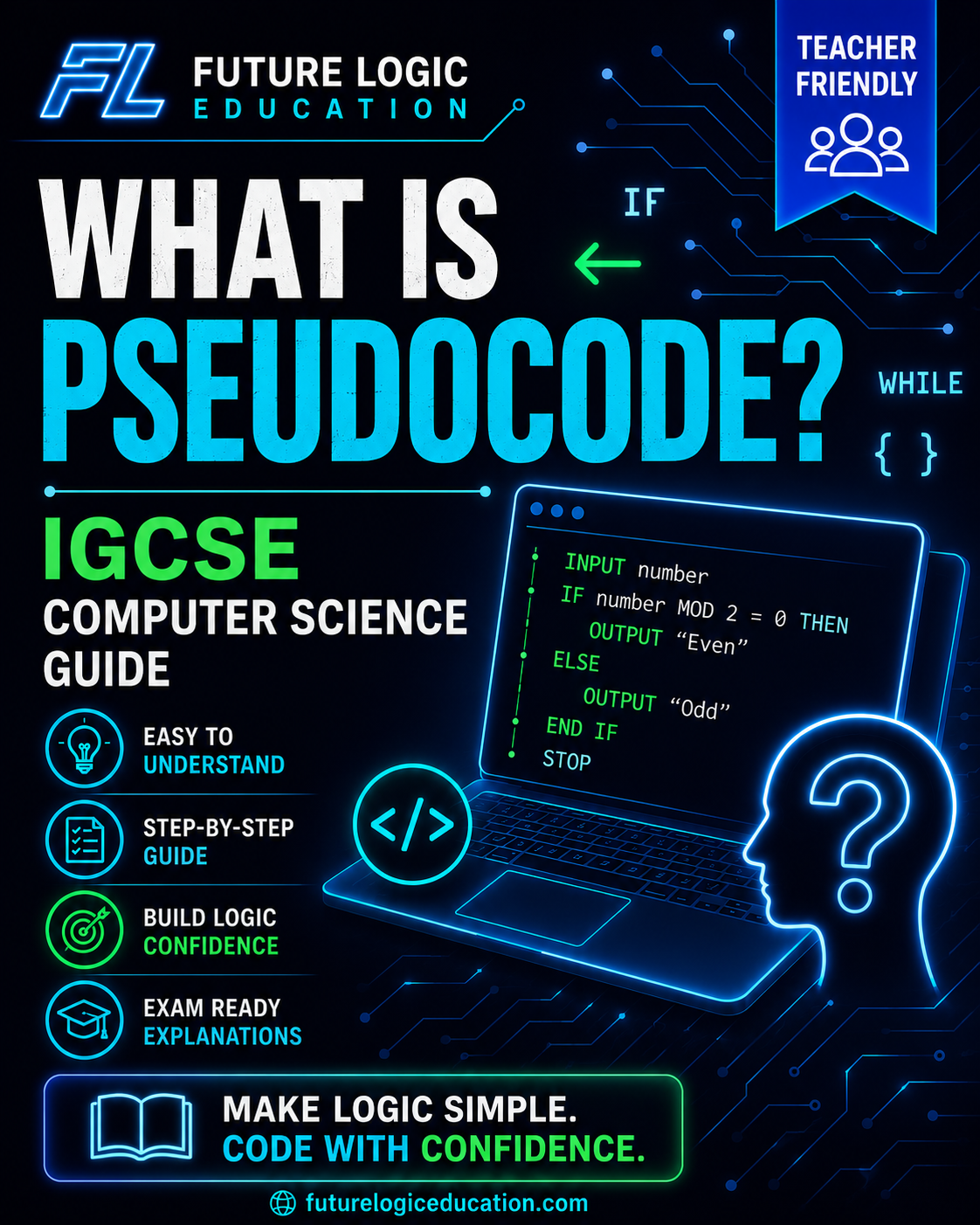
Here is a short pseudocode program that checks whether a number is even or odd — the same example shown on our guide image above:
IF number MOD 2 = 0 THEN
OUTPUT "Even"
ELSE
OUTPUT "Odd"
END IF
STOP
Notice how the logic is immediately clear, even without knowing any specific programming language. That clarity is exactly what Cambridge examiners reward.
Common Mistakes to Avoid
- Forgetting to close an IF statement with END IF or a loop with NEXT / ENDWHILE.
- Using programming-language syntax (such as
print()or==) instead of Cambridge pseudocode conventions. - Writing vague steps like "check the number" instead of a precise condition.
- Mixing up WHILE (condition checked at the start) and REPEAT…UNTIL (condition checked at the end).
How to Get Better at Pseudocode
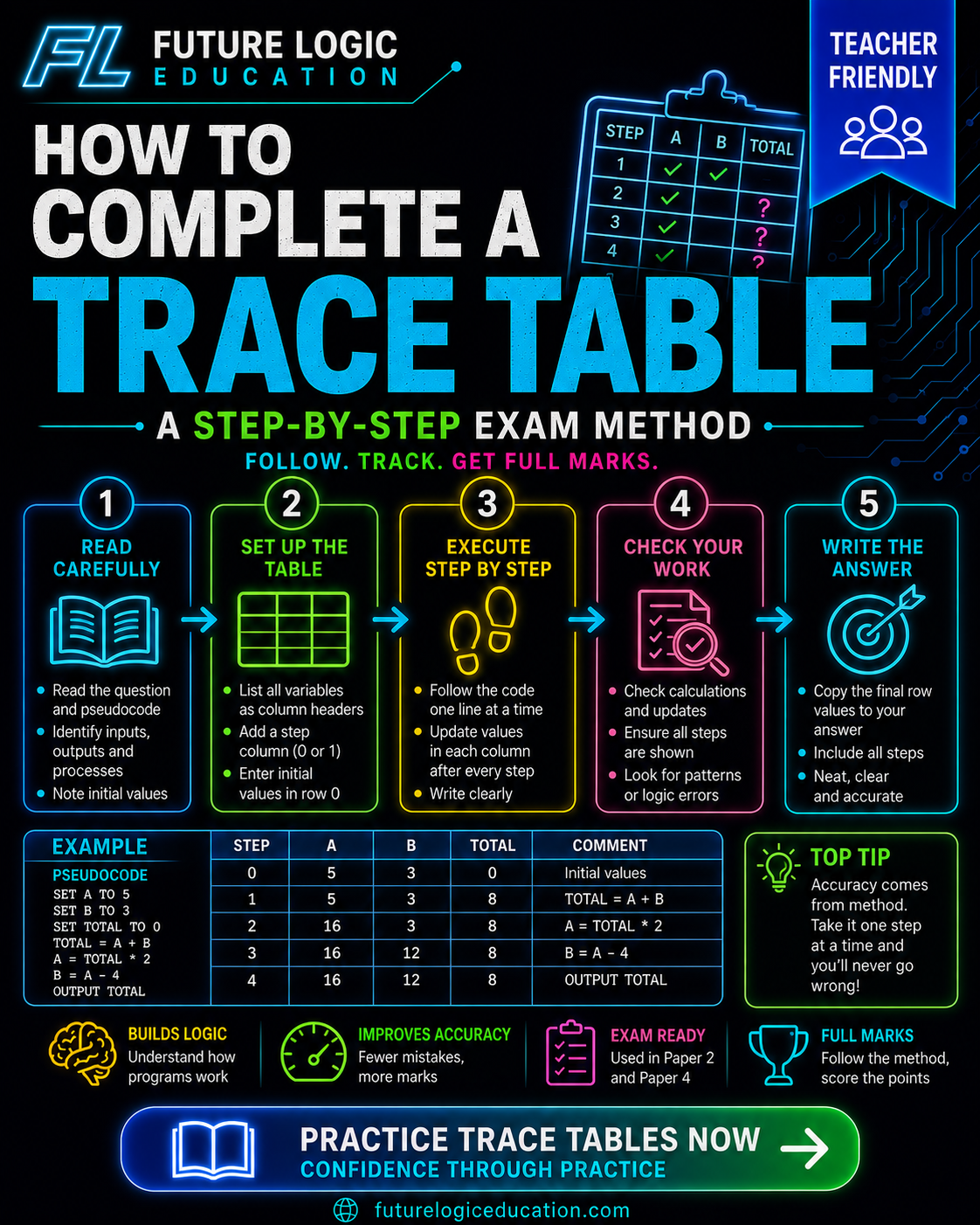
The best way to improve is to write pseudocode regularly — not just read it. Start with simple problems, trace through your logic step by step, and then check your answer against Cambridge mark schemes to see exactly what language the examiners expect.
FutureLogic trainers guide you through pseudocode from first principles, with interactive practice, worked examples and exam-style questions that build your confidence one step at a time.